
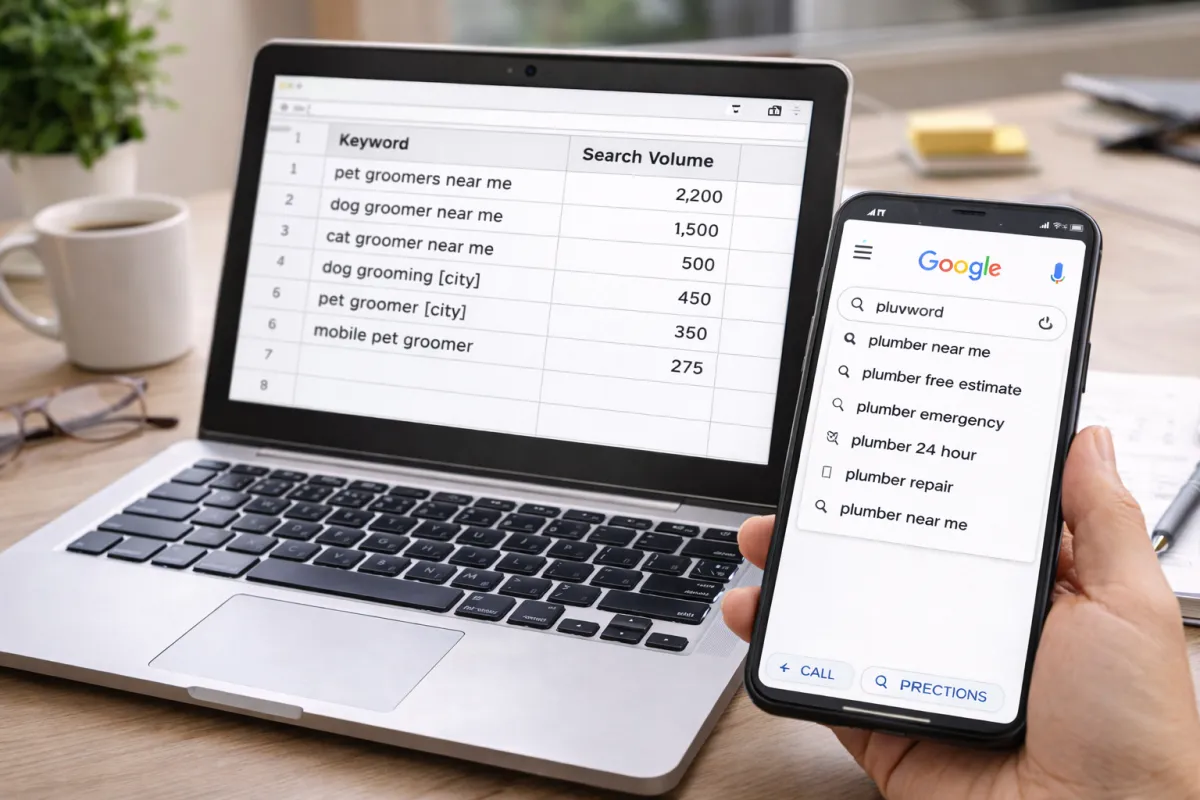
Local SEO Keyword Research for Small Businesses (2026)
If you want more calls from Google, you need to target what people actually type into search. That starts with local SEO keyword research. This is not about chasing “big” keywords. It is about finding the searches that bring real customers to your service area.
Simple rule: The best local keywords usually include the service, the location, or a “near me” style intent.
On This Page
What is local SEO keyword research?
Why keyword research matters for local businesses
The 3 types of local SEO keywords
What is local SEO keyword research?
Local SEO keyword research is how you identify the searches your nearby customers use when they want a service. You use those keywords to build or improve pages that Google can rank in Search and Maps.
Why keyword research matters for local businesses
Without keyword research, most business websites end up talking about the wrong things, on the wrong pages, in the wrong way. Then Google does not know when to show you.
It tells you what customers want right now.
It helps you build pages that match real searches.
It makes your SEO work more focused and easier to track.
It helps you compete with businesses that already rank.
The 3 types of local SEO keywords
1) Service keywords
These describe what you do.
pool repair
junk removal
roof repair
2) Location keywords
These describe where you serve.
Lake Havasu City
Las Vegas
Phoenix
3) Combined keywords
These combine service plus location and often convert best.
pool repair Lake Havasu City
junk removal Fresno
roof repair Phoenix
How to find local keywords
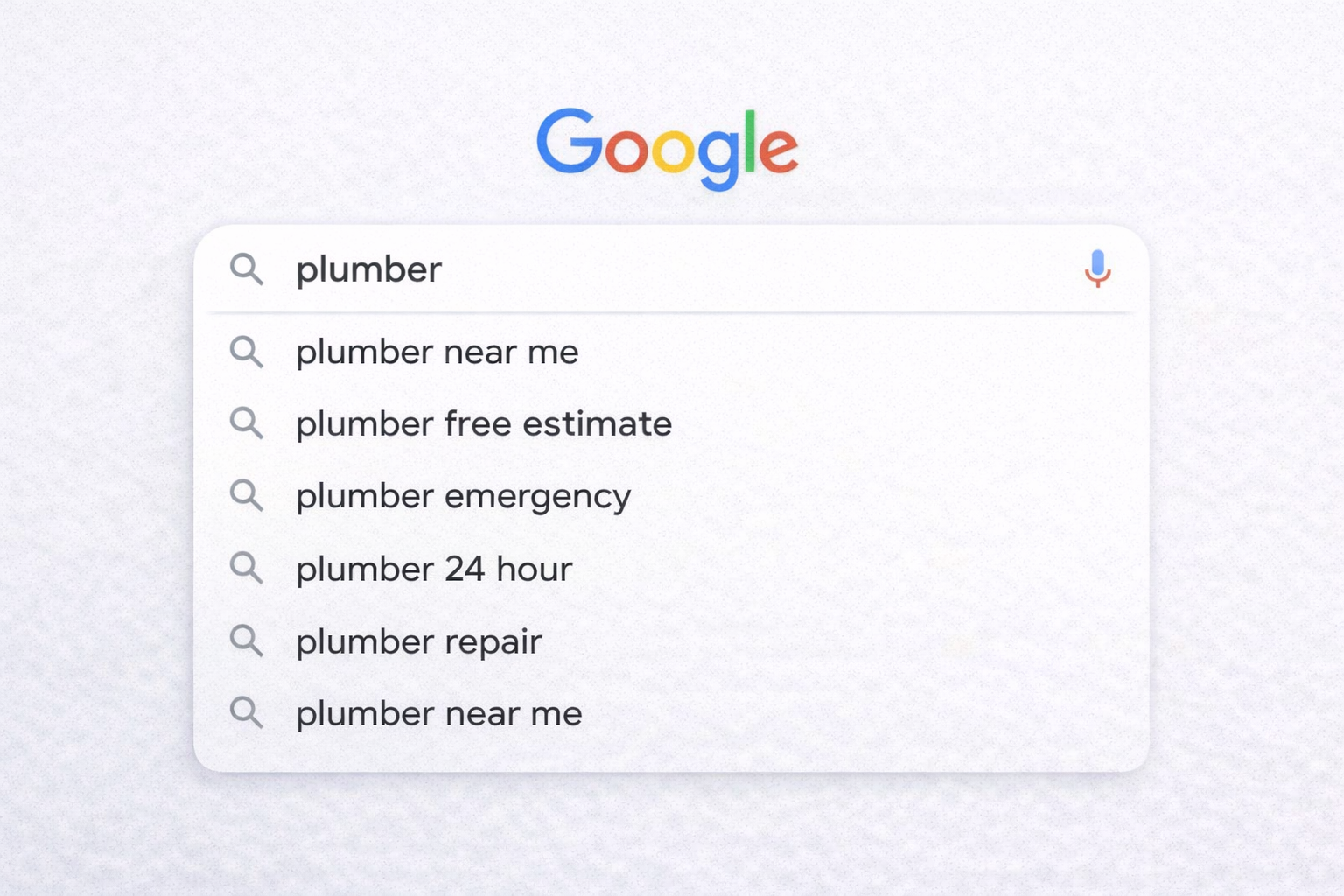
1) Use Google autocomplete
Start typing your service into Google and watch the suggestions. Those are based on real searches. Try adding your city, “near me”, and different service words.
2) Look at top competitors
Search your core service and open the top sites. Look at their page titles, headings, and service pages. You are not copying them. You are learning what Google seems to reward in your market.
3) Use a keyword tool for ideas
Tools like Google Keyword Planner, Semrush, Ahrefs, or Ubersuggest can help you find variations and related searches. Do not obsess over search volume. Focus on intent and relevance to your service.
Important: A “low volume” keyword can still bring you leads if it shows strong intent and matches your service area.
Where to use your keywords
Once you have your keyword list, use it in the places that matter most.
Page title and H1
Main service page headings (H2 and H3)
Intro paragraph and service description
FAQ section on the service page
Internal links between related pages
Image alt text where it fits naturally
A quick example that fixes a common mistake
Many sites use a generic page title like “Services”. Google cannot rank that well because it does not say what the page is about.
Weak: Services
Stronger: Pool Repair in Lake Havasu City
Common keyword mistakes
Only targeting one keyword for the whole website.
Trying to rank for huge national keywords that do not match local intent.
Not building separate pages for separate services.
Skipping location intent, especially “near me” style searches.
Using keywords in weird ways that sound unnatural.
A simple keyword plan that works for most local businesses
Most local businesses do fine with a focused plan:
Pick 5 to 10 core services you want to sell.
Create one solid page per service.
Add location intent where it fits (cities served, service areas).
Support those pages with helpful posts and internal links.
Want help choosing the right keywords and building pages that rank?
See our SEO services for local businesses. We can map keywords to pages, fix the site structure, and track what is driving calls.
Related reads: What SEO for local businesses means and Google Business Profile SEO.